

 Français
 Español
For over twenty years, L’Atelier de la Table has been building lasting relationships with local partners in Asia.
Our expertise is based on two complementary histories.
The first takes us to the forests of northern and central Thailand, where our solid acacia tabletops are made.
The second leads us to the island of Java, in Indonesia, the birthplace of our teak root creations. In both cases, we are driven by the same philosophy: to work with patience, respecting nature, people, and local traditions.
Thailand: where nature meets artisanal know-how!
The Story of L’Atelier de la Table
L’Atelier de la Table was born from a simple conviction: the most beautiful creations always begin with respect for nature.
For over twenty years, we have traveled through the countryside of northern and central Thailand, meeting local farmers. They are the ones who know each tree, its history, its age, and its environment.
This relationship of trust is essential: it allows us to select mature trees, respecting natural resources and local communities.
Each project begins long before the creation of a table.

The choice of the tree
It all begins in the forest.
Together with the farmers, we select the trees with the finest qualities: their shape, grain, diameter, and potential.
Each trunk is unique, and we already envision the future tables, consoles, or worktops it could become.

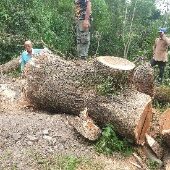

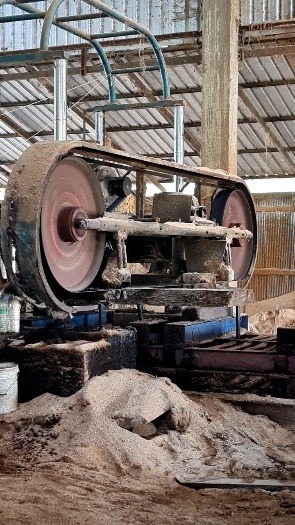
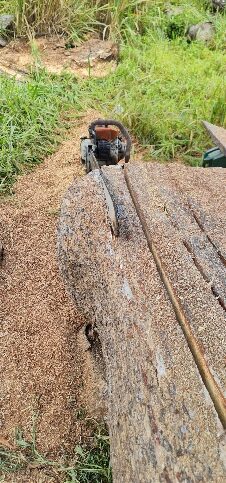
When the land is accessible, the logs are transported to a sawmill where they are precisely cut.
In more difficult-to-access areas, the sawing is done directly on site, using a chainsaw, in order to preserve the full quality of the wood.
Quality above all
Unlike industrial methods, we never cut a tree without being certain that the planks can be immediately placed in a drying oven.
This step is essential. It prevents the development of wood-boring insects, significantly reduces the risk of warping, and guarantees optimal quality from the very first days after cutting.
Drying: the most important step
Drying is undoubtedly the most important step in the production of a quality tabletop.
As soon as they are cut, the tabletops are placed in a kiln according to a rigorously controlled process. Contrary to popular belief, it’s not simply a matter of “heating” the wood.
The cycle begins with a moisture saturation phase: the tabletops are thoroughly moistened with steam. This step ensures uniform moisture throughout the wood and prepares it for gradual drying, thus limiting internal stresses that could cause cracks or warping.
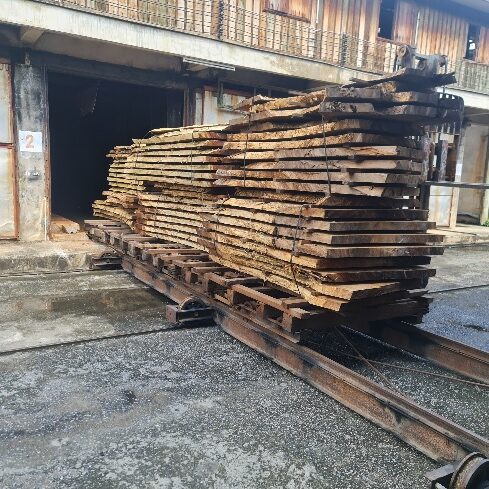
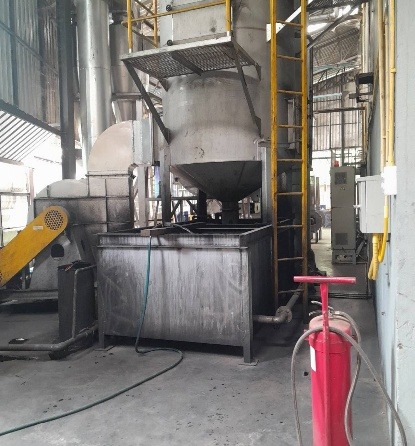
The temperature is then gradually raised to approximately 125°C before being slowly lowered over several weeks. Throughout the entire process, regular humidity checks are carried out to precisely monitor the moisture content.
The trays remain in the kiln for a minimum of six weeks. They are only removed after several successive checks confirm a moisture content of 15% or less, a threshold we consider essential to guarantee stable and durable wood.
We have also chosen to abandon the old wood-fired kilns in favor of fully electric kilns. This process represents a larger investment, but it allows us to control the drying cycles much more precisely while eliminating direct emissions from wood combustion.
For us, this step is crucial: perfectly controlled drying is the best guarantee of a piece of furniture that will retain its stability and beauty for many years.
A limited working window
Once it’s out of the kiln, time is of the essence.
We allow ourselves about a month to shape, work, and prepare the tray before it can naturally reabsorb moisture.
This process allows us to preserve all the qualities acquired during drying.
The work in our workshop
The arrival of the trays
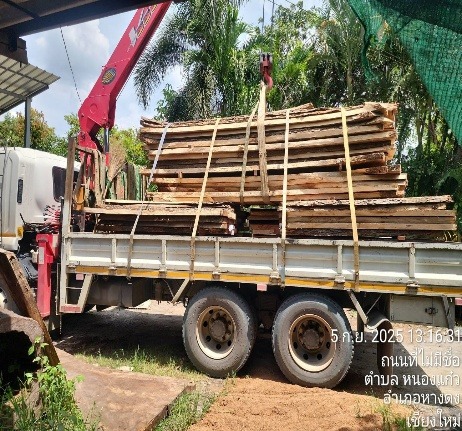
After several weeks in a kiln, the trays arrive at our workshop to begin their transformation.
At this stage, the wood is dry and stabilized, but the work is just beginning.
Each tray is individually inspected to determine the necessary steps before it is finished.
Flattening
Even before drying, all our boards are intentionally cut to a thickness of approximately 10 cm.
This extra thickness is not accidental. It allows the wood to dry under optimal conditions and minimizes the risk of warping.
Once drying is complete, we gradually reduce each board to its final thickness, generally between 7 and 8 cm, depending on its dimensions and length.
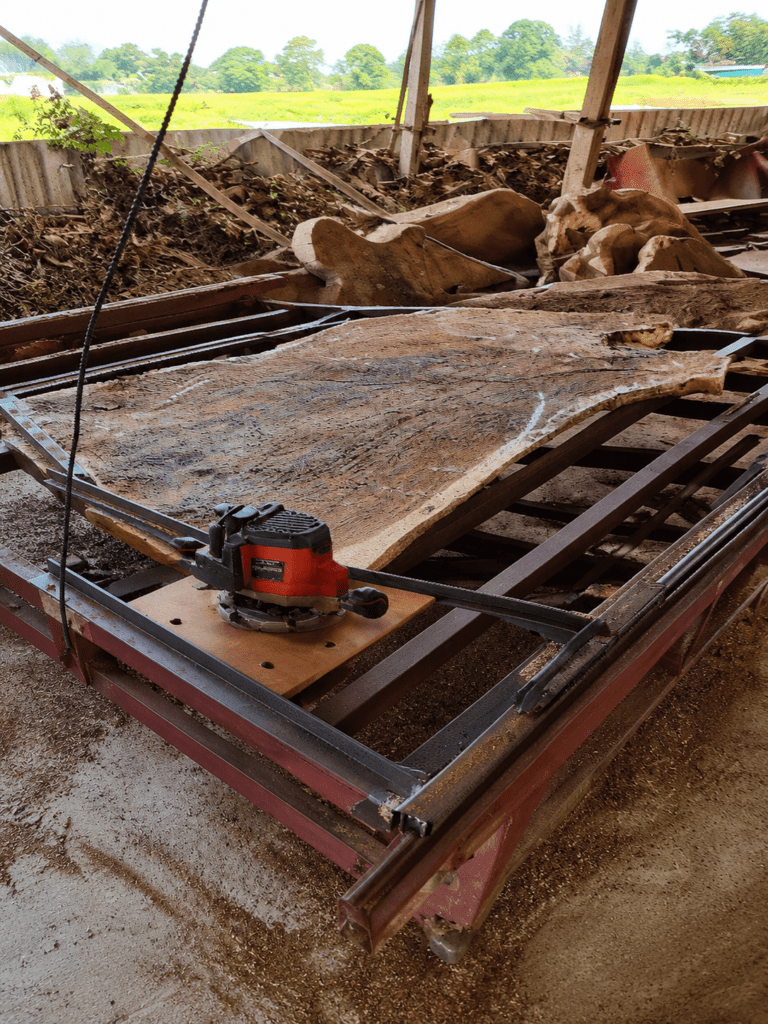
If a board has warped slightly during drying, we flatten it perfectly.
For this, we use a large surfacing table entirely handcrafted in our workshop using traditional methods.
The surfacing is done using a router equipped with a 40 mm diameter bit.
To preserve the wood fibers and achieve perfect flatness, we remove a maximum of one millimeter of material with each pass.
This operation requires several hours of work for a single tray, but it guarantees a result of exceptional precision.
Sanding
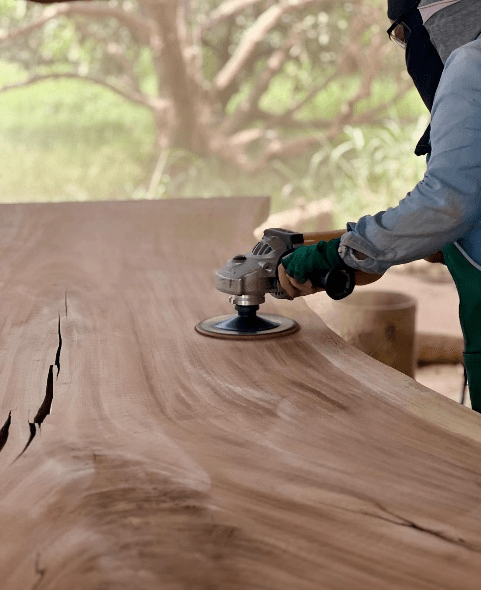
Once the tabletop is perfectly flat and to its final thickness, one of the longest steps begins: sanding.
We proceed progressively with several grits of sandpaper to obtain a perfectly smooth surface while respecting the natural grain of the wood.
Each tabletop is successively sanded with the following grits:
40 → 80 → 120 → 180 → 240 → 320
No step is skipped.
This meticulous work reveals the full richness of the grain while perfectly preparing the wood to receive its finish.
A premium finish
After thorough dust removal and final surface preparation, each tray receives a two-component polyurethane finish, renowned for its resistance to impacts, stains, and moisture.
We apply three complete cycles, each consisting of two coats.
Between each cycle, the tray dries for 24 hours before being carefully sanded to ensure perfect adhesion between the coats.
We use the following sandpaper in succession:
- 600-grit sandpaper after the first cycle.
- 800-grit sandpaper after the second cycle.
- 1000-grit sandpaper after the final cycle.
This meticulous process results in a deep, even finish that is exceptionally pleasant to the touch.
Nearly six months of preparation, attention to detail.
Between the farmer’s selection of the tree and the arrival of the tabletop in our workshop, an average of six months passes.
Six months during which every step is carefully considered to prioritize quality over speed. Each table, console, worktop, or bar counter that leaves our workshop is the result of several months of work, patience, and exacting standards.
We deliberately choose to produce less, but produce better.
This philosophy is what defines L’Atelier de la Table today: taking the time to create unique pieces, designed to last for generations.